C3 → CAM Transcriptomics
Low-cost CO₂ sensing, Nanopore sequencing, and HPC bioinformatics used to investigate drought-induced CAM behavior in Coleus amboinicus.
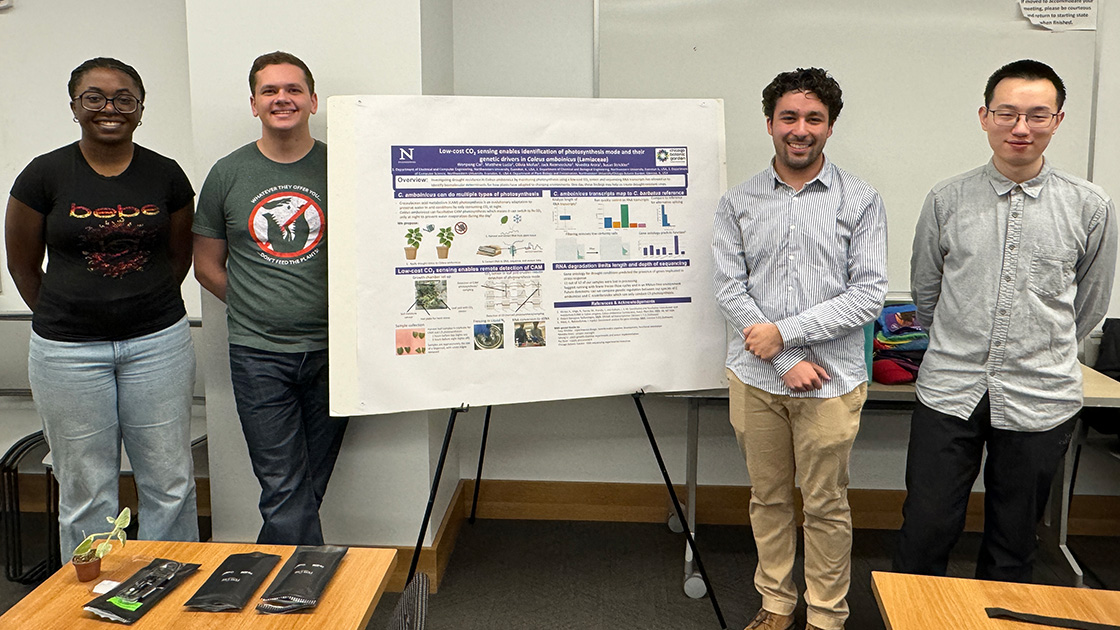
Overview
The project investigated how Coleus amboinicus switches from C3 photosynthesis toward CAM under drought stress. Our workflow combined controlled plant growth, a low-cost Arduino-based sensing system, comparative RNA sequencing, and computational analysis.
CAM plants fix CO₂ at night. We used changes in CO₂ and humidity around enclosed leaves to distinguish CAM behavior, then paired the physiological measurements with transcriptomic analysis to investigate potential genetic drivers of the response.
Experimental pipeline
Plants were grown under controlled light and water conditions, with well-watered C3 and drought-stressed CAM conditions.
An Arduino-based system recorded CO₂, humidity, soil moisture, and temperature at six-second intervals.
Leaf tissue was collected at two circadian time points and prepared for RNA extraction and cDNA conversion.
Barcoded cDNA was sequenced on an Oxford Nanopore MinION for long-read transcript analysis.
Computational workflow
transcriptome mapping
de novo assembly
UniProt TrEMBL
functional annotation
All bioinformatics analyses were run on Northwestern's Quest HPC system through the command line. Because no public C. amboinicus reference genome was available, the workflow used a Coleus barbatus reference genome for alignment.
Results
The low-cost CO₂ sensing system successfully distinguished CAM from C3 behavior. The drought-stressed plants showed nighttime CO₂ drawdown and humidity spikes, while the control group was more stable.
The RNA sequencing component was substantially limited by degradation during sample preparation: 11 of 12 samples were lost, leaving one surviving sample for transcriptomic analysis. That sample mapped successfully to the C. barbatus reference. Its recovered transcripts included functional categories associated with signaling and regulation, metabolism, photosynthesis, ribosomal/translation processes, stress/redox, and lipid/wax.
The transcriptomic findings are preliminary. With only one surviving sample, the project could not provide the depth or replication needed for strong statistical conclusions. The report instead treats the observed stress- and photosynthesis-associated transcripts as findings consistent with the hypothesis and identifies improved RNA handling as a key direction for future work.
What I worked on
- Contributed to the experimental and computational workflow for studying C3-to-CAM behavior.
- Worked with the Arduino-based CO₂, humidity, and soil-moisture sensing system and its Python data analysis.
- Worked with the Nanopore sequencing and transcriptomic analysis pipeline on Quest HPC.
- Used command-line bioinformatics tools for read QC, filtering, transcriptome mapping, assembly, protein annotation, and Gene Ontology analysis.
- Interpreted the computational results in the context of the physiological sensing data and the project's experimental limitations.